


For many genealogists, the thrill of discovery is often dampened by a frustrating reality: after hours of research, an ancestor remains nothing more than a ghost of ink and parchment. They exist as a static name, a single date, and perhaps a one-word occupation on a faded register. This “dry data” feels disconnected from the vibrant, breathing person they once were. As I work on building the stories for my ‘sixteens’ my great grandparents on both maternal and paternal lines, I realise I need to dig deeper to reveal their stores. I have done the consistent genealogy research - stretching back over 30 years now, but I still don’t really ‘know’ my great grandparents.
This is where 'Archival Alchemy' comes into play. Instead of treating my records as final destinations, I use AI to transform the heavy weight of a 19th-century ledger into the dynamic energy of a lived experience. Archival Alchemy involves rigorously synthesising raw archival data with sensory layers and historical context. My approach is not about fabrication, but reconstruction — using the power of AI to bridge the gap between dusty archives and high-tech narratives, and transform lists of facts into resonant human stories.
Takeaway 1: Occupations are Actions, Not Labels
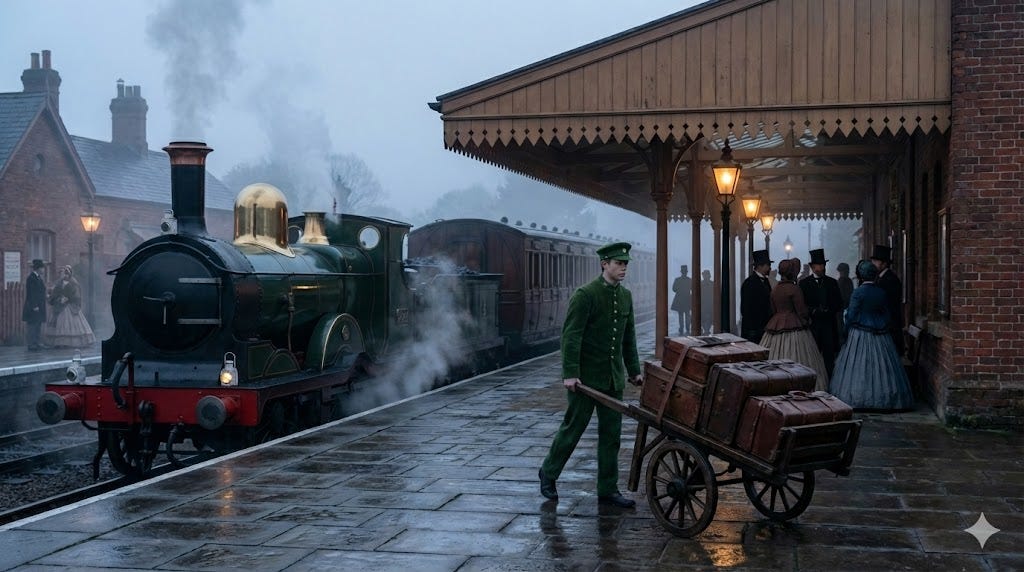
In the realm of traditional genealogy, an ancestor’s job is a static label. In 1862, a register entry lists my mother’s grandfather, George Robinson, simply as a “Porter.” To the casual observer, this is a title; to me, as the Historical Data Alchemist, it is a catalyst for depicting daily physical struggle.
AI enables me to transform this label into a story of motion. By examining the operational context of the era—marked by quick turnarounds and confined station spaces—I can shift George from a mere line in a ledger to a person of physical reality. He wasn’t just “employed”; he was wrestling heavy trunks and carpet-bags, guiding frantic passengers through a maze of iron and steam.
George navigated the wet, sooty platforms in a green corduroy jacket, waistcoat, and trousers, his movements anchored by heavy boots and a peaked cap bearing a metal “PORTER” badge. His workday was a relentless sequence of physical beats, governed by the unforgiving pressure of the railway clock.
By defining these sartorial and functional details, the history becomes grounded. I now see the weight of the luggage and the grime of the platform, turning a job title into a tangible life.
Takeaway 2: Reconstructing the “Smell” of the Past
To move beyond the flat surface of a historical backdrop, we must engage more than just the eyes. AI synthesises historical data to recreate the “sensory atmosphere” of a location, drawing from specific visual textures found in the record.
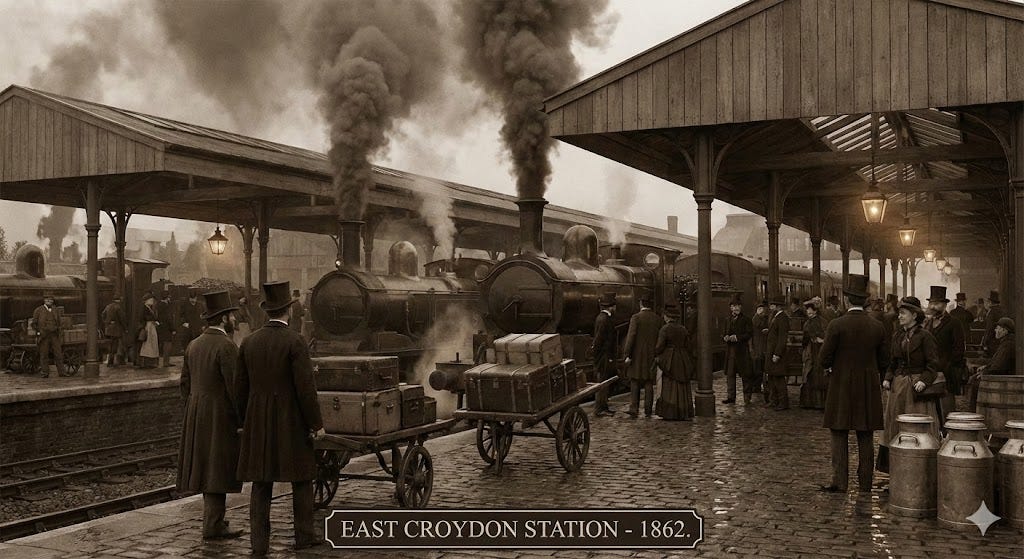
Take East Croydon Station in 1862. The data tells me George worked there, but Archival Alchemy reconstructs a world that is crowded, smoky, and rapidly expanding. The AI layers the scene with auditory and olfactory details that make the environment breathe:
Visual & Auditory: The rhythmic clanking of steam engines and the piercing squeal of iron brakes beneath timber platform roofs and simple ironwork.
Olfactory: A thick, heavy cocktail of coal dust, lubricating oil, and the scent of wet wool from passengers’ coats.
Physical Texture: The sight of milk churns and luggage barrows standing under the dim glow of oil lamps.
These details ground my ancestor as a character in a tangible world. It transforms the station from a point on a map into a vivid setting where the past feels within reach.
Takeaway 3: The Power of “Locality Guides” and Environmental Contrast
AI-driven “Locality Guides” allow us to define the specific character of a place, creating emotional resonance through contrast. For the Robinson family, the movement between the village of Banstead in Surrey to the suburban areas of Croydon represents a profound shift in existence.
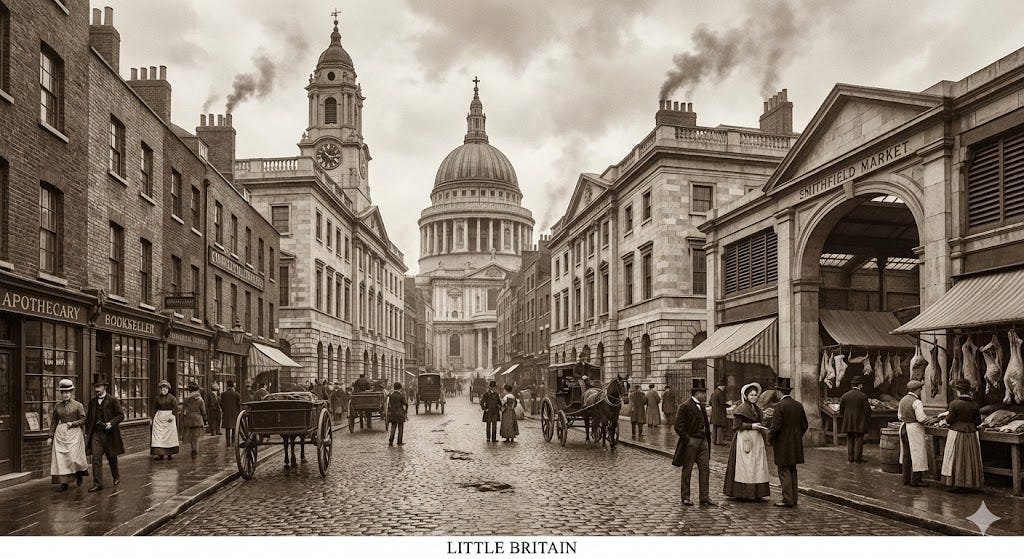
I imagine the Robinson family travelling by train into London and visiting such localities as the Smithfield Market in an area now called Little Britain.
The guide for Little Britain reveals a “rough yet refined” commercial intensity. It was a neighbourhood where commerce, medicine, and spirituality collided, situated between the ancient St. Paul’s Cathedral, St. Bartholomew’s Hospital, and the “blood and industry” of the newly rebuilt Smithfield meat market.
Contrasting this urban intensity with the “wholesome air” and “sheep-grazed slopes” of Banstead and the tranquil life on the suburban streets of Croydon allows me to explore the emotional impact of my ancestor’s migration. Defining these environmental “characters” adds weight to my family’s journey, highlighting the vastly different worlds they navigated as they moved from the quiet, open country to the crowded urban and suburban spaces of Surrey.
Takeaway 4: Your Ancestors Lived Through “Epic Sagas”
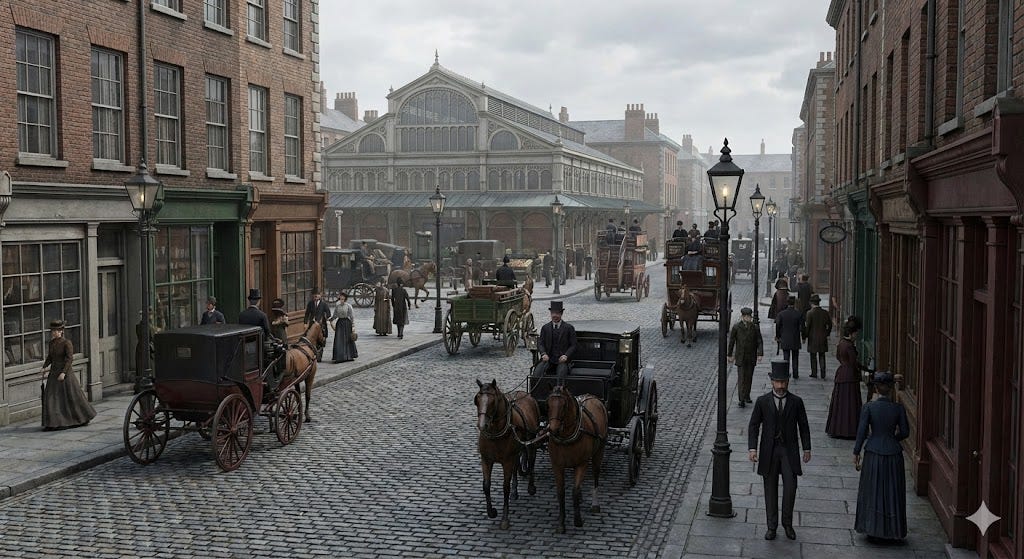
When we anchor personal timelines to massive external events, family history is elevated into a saga of survival. My mother’s mother, Mary Jane Robinson (1872–1954), daughter of George Robinson, did not just live for 82 years; she witnessed a total “transportation revolution.”
Born in a Victorian market town of 60,000 people, Mary Jane’s life spanned the transition from horse-drawn vehicles to the birth of the Aviation Age. AI helps us track this evolution through specific milestones: the introduction of electric trams in 1901 and the 1920 opening of Croydon Airport, featuring the world’s first purpose-built Art-deco terminal in 1928.
Mary Anne Robinson, George’s wife, was the quiet Welsh matriarch who supported George as he rose from Porter to Head Porter and finally Inspector. His life, and by default, hers; revolved around the busy timetable of the East Croydon station just 15 minutes walk from their home at 70 Gloucester Road, Croydon.
I now have a more vivid image of their lives and feel more connected to this pioneering Robinson family.
Takeaway 5: Missing Data is a “Detective Story,” Not a Dead End
One of the most potent applications of AI in genealogy is “analytical critique.” Instead of ignoring gaps in the record, AI identifies them as “missing links,” turning the research process into a suspenseful quest for specific primary sources.
For example, while a record exists for George Robinson in 1862, his documented promotion to Inspector occurred between 1871 and 1881. The AI identifies this as a narrative gap, directing me away from general publications and toward specific repositories: The National Archives (TNA) in Kew. It points specifically to the RAIL series, such as RAIL 414, Piece 771, to find the exact moment of his ascent.
“To maintain historical rigour, we must move beyond secondary assumptions through data triangulation. By comparing traffic staff registers against census returns and birth registrations, we can definitively pin down the grade changes and pay increases that define a career.”
This approach turns me into a detective, seeking out the “ingredients” of a promotion to solve the mystery of my ancestor’s professional rise.
Conclusion: The Future of Our Past
The methodologies of sensory layering, environmental contrast, and historical anchoring change the way we perceive our lineage. We are no longer limited to the “dry data” of the archives. By using AI as a tool for reconstruction rather than fabrication, we can resurrect the physical toil, the sensory environment, and the epic historical context that defined our ancestors’ lives.
These techniques transform genealogy from a hobby of collection into an act of resurrection. Our ancestors’ stories are waiting to be told; we simply need the right alchemical tools to breathe life into them.
Follow the story of George Robinson’s life on the Railways in my Family History Digital Archive at WeAre.xyz.
From Surrey Fields to the Age of Steam
AI Notes: this blog post was created inside NotebookLM and illustrated by Nano Banana images from Gemini 3.
If you could step into a single sensory moment from your great-grandparent’s workday, what would you want to hear, smell, or feel first?
How would you like to take your first steps into using AI for your Genealogy?


