
The Census Return That Would Not Behave
Slow down, go back, revisit records and ask AI to clarify.

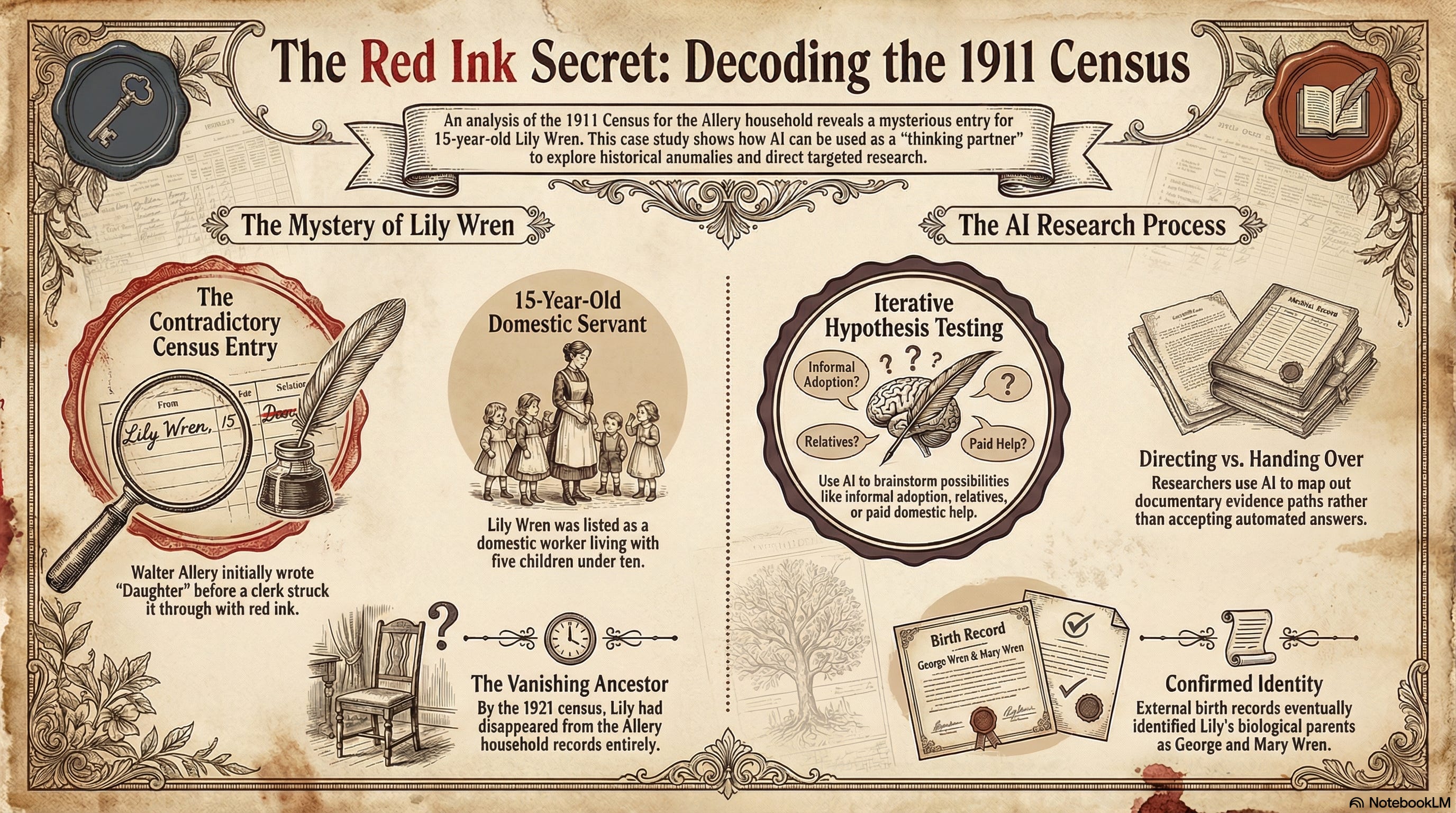
There is a name in the 1911 census that does not belong.
At London House, Surbiton, my great-grandmother Harriet has five children gathered around her: Cecil, Edward, William, Imee, and Samuel. And then, listed quietly beneath them, is a fifteen-year-old girl named Lily Wren. Occupation: domestic. Relationship to head of household: initially written as girl, then struck through in red ink by a census clerk who had written daughter.
That red-edited word is what stopped me.
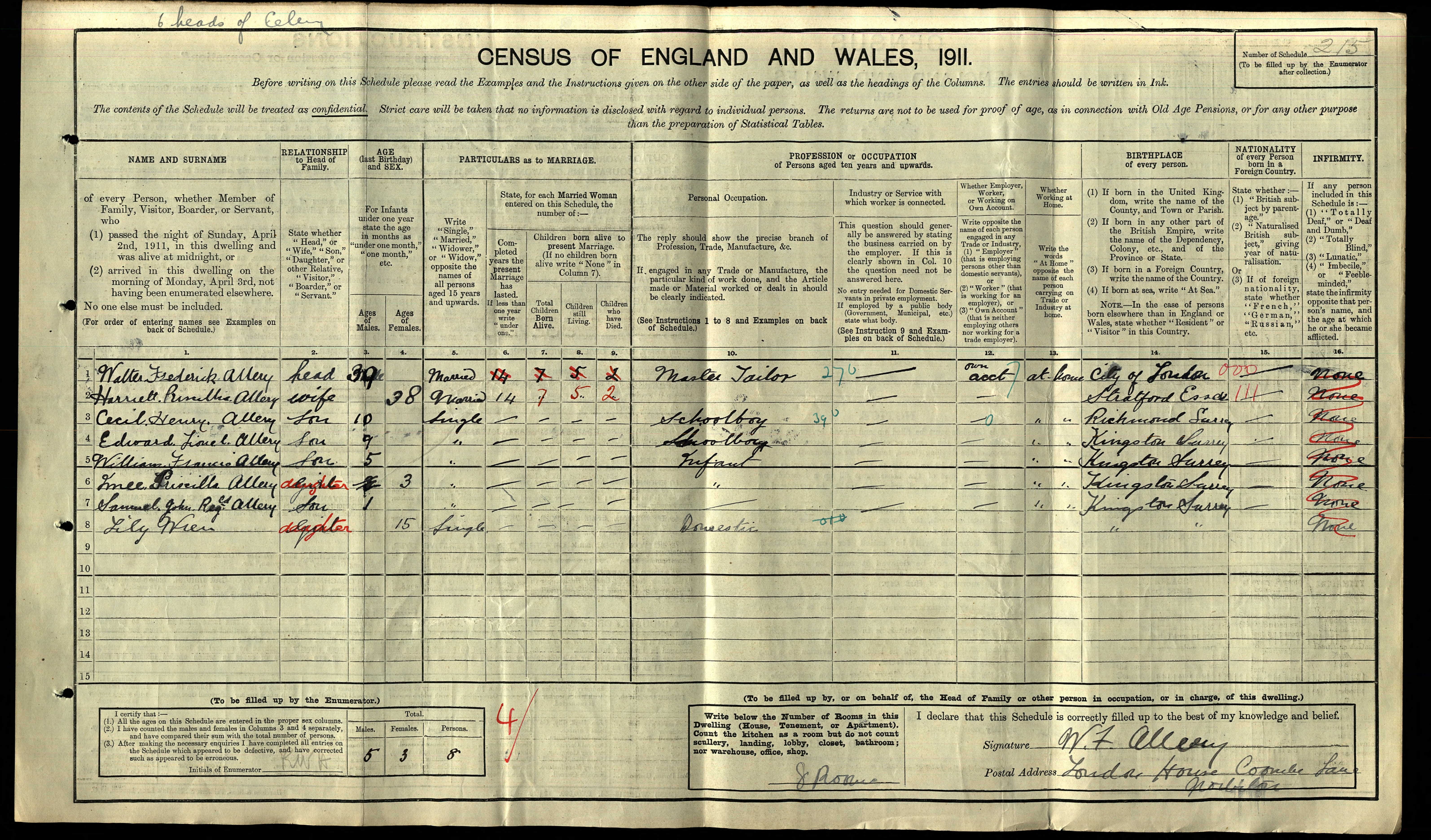
I have been working through the Allery household records intermittently, moving between the 1911 and 1921 returns, trying to break down this small brick wall. By 1921, Walter was dead, Harriet was managing alone, and Lily was gone. No trace, no explanation. Just a household that had once held her, and a record that could not quite decide what she had been.
I revisited a memoir from one of my uncles who lived at London House, Coombe Lane, to reveal any details about live-in domestics. Uncle Bill mentioned they had a Nanny named Emily who had married and moved away; replaced by a new Nanny (unnamed) who apparently, was not as lenient with their childhood games. Could Emily be Lily?
I brought the question to AI (I used Gemini 3 Thinking model).
Not to be answered. I was asking it to help me think — to lay out the logical explanations for a girl whose presence in a family record had been almost, but not quite, erased. I uploaded both transcribed returns and opened the conversation: What could account for this? The response came back precise, structured, and immediately useful.
The possibilities were clear. Lily may have been a paid domestic, taken on to help Harriet manage five children under the age of ten. She may have been a relative, informally absorbed in the way Edwardian families sometimes managed without paperwork. Or she may have been something harder to categorise: a girl who arrived as help and stayed as family, which would explain why Walter’s first instinct, setting ink to paper, was to write daughter.
That one exchange gave me simple, solid research to pursue.
Birth records list Lily as born in Kingston, to George and Mary Wren. Evidence suggests she married in 1924 and settled into the Surrey suburbs she had always called home. The chapter with the Allerys had closed long before anyone thought to look for her.
That was yesterday. Today, Sunday, I did that final bit of research with GRO to follow up on what the AI tool had claimed. That gave me the last piece of the puzzle; the full name for this child born to George and Mary Wren in Kingston in 1895. Her name was recorded at birth as ‘Lily Emily Wren and her mother’s maiden name was recorded as Duffell.’
That confirmed this person as the ‘nanny’ referred to in my Uncle Bill’s memoir; the dates fitted; the name was confirmed, and I could now picture Emily’s presence in the household listed in the 1911 census for London House, Coombe Lane.
That is what iterative conversation does. You do not ask once and accept what comes back. You push, you feed the next confirmed fact, you ask what the documentary record would look like if each hypothesis were true — and then you go and find out. The AI lays out the options. You decide which ones the evidence supports.
Start with the return that has been bothering you. The one with the wrong age, the absent spouse, the name that appears once and vanishes. Upload the transcription. Open the conversation. Work through the explanations, clearly labelled, with nothing assumed and everything checked.
You are not handing your research over. You are directing it. There is a difference, and once you feel it, you do not go back to working alone.
Lily has been waiting for someone to understand what she was to that family and why the ink still carries the shape of the word Walter almost used. She has waited long enough.
CTA: There is one more ‘mystery’ item on the 1911 census displayed above. See if you can find it and offer some plausible explanation for its presence on this record.
Which ancestor in your research has been waiting just as patiently?
Genealogy Assistant Claude @ Anthropic
This is such a satisfying example of what happens when you slow down and really listen to a record. That single crossed-out word turns a routine entry into something much more human and uncertain. I also really like how you describe using AI as a way to structure possibilities and then go back to the sources. It mirrors good genealogy at its best: question, test, revisit. It’s a reminder that the most interesting stories often live in the small inconsistencies the records that “won’t behave.”
Loving your graphics